
Your Immune System Is Not Seasonal. Neither Should Your Routine Be.
September 16, 2026
A practical guide to year-round immune resilience — and how Immune Guard fits into a smarter daily plan.
Most people treat immune support like an umbrella: they reach for it when the weather turns. That is understandable. Colds cluster in fall and winter. Travel, school, and office season pile on extra exposure. Stress spikes. Sleep slips. Then January arrives and the cabinet fills with bottles we forget by April.
That pattern misses how immunity actually works. Your immune system is not a switch you flip when someone nearby sneezes. It is a 24/7 network — barriers, cells, signaling molecules, and a gut lining that houses a large share of your immune tissue. It needs consistent raw materials, not a once-a-year panic stack.
This post walks through what current research actually supports, what daily habits move the needle, and where a multi-nutrient formula like Immune Guard belongs in a realistic routine.

Immunity is a system, not a single vitamin
A healthy immune response depends on several layers working together:
- Physical barriers — skin, mucous membranes, and the gut lining that keep unwanted microbes from crossing into the body.
- Innate immunity — the first-response team: neutrophils, natural killer cells, and other rapid defenders.
- Adaptive immunity — T cells and B cells that learn, remember, and respond more precisely over time.
- Regulation — the ability to respond strongly, then stand down. Over-activation is not the same thing as strength.
No single nutrient runs that whole system. Vitamin C supports immune-cell function and antioxidant defense. Zinc is required for the development and signaling of several immune cell types. Botanical compounds such as elderberry anthocyanins have been studied mainly for seasonal respiratory comfort. Gut-supportive ingredients matter because roughly 70% of immune cells live in or around the intestinal tract.
That is why “one mega-dose of vitamin C when you feel off” is a thin strategy. A better approach is covering the basics every day, then layering extra support during higher-demand weeks — travel, poor sleep, heavy training, or crowded indoor seasons.
What the research actually says (without the hype)
Supplement marketing often oversells prevention. The science is more modest — and still useful if you read it honestly.
Vitamin C
Large reviews of regular vitamin C intake (typically 200 mg or more per day) have not shown a clear drop in how often the average person catches a cold. They have shown a modest reduction in how long colds last — on the order of about 8% in adults and more in children — and a larger benefit in people under heavy physical stress, such as endurance athletes. Vitamin C also supports collagen, iron absorption from plant foods, and the antioxidant protection immune cells need when they generate oxidative bursts to fight microbes.
Takeaway: vitamin C is a daily foundation nutrient, not a miracle “cold stopper.” Consistency matters more than a 2,000 mg rescue dose after symptoms start.
Zinc
Zinc is essential for T-cell maturation, barrier integrity, and normal immune signaling. Even mild shortfalls can blunt response. Preventive doses in the 15–30 mg range have been studied for respiratory wellness, especially in people with low intake (older adults, people with limited diets, and those with digestive issues that impair absorption).
High-dose zinc lozenges taken at the first sign of a cold have the strongest evidence for shortening illness duration — but that is a different use case than a daily capsule. Daily Immune Guard-style formulas typically use moderate zinc for ongoing support, not the high lozenge doses used in short-term trials.
Elderberry
Elderberry (Sambucus nigra) extracts are rich in anthocyanins. Small randomized trials and a 2019 meta-analysis found reductions in the duration and severity of upper-respiratory symptoms when elderberry was used around illness. Evidence for taking it every day, year-round, as a preventive is thinner. Think of elderberry as a useful botanical in a broader formula, not a proven shield you can rely on alone.
The gut–immune axis
This is the piece most “immune boost” articles skip. Immune cells in the gut learn from the microbes living there. A diverse, well-fed microbiome helps train tolerance (so the body does not overreact) and readiness (so it can still respond). Fiber-rich plants, fermented foods, sleep, and avoiding unnecessary antibiotics all influence that conversation.
Ingredients such as L-glutamine (used by intestinal cells as fuel) and probiotic strains like Lactobacillus acidophilus are included in Immune Guard specifically to support that gut-first pathway — not because they “kill germs,” but because barrier and microbiome health sit upstream of immune tone.
Supporting botanicals
Echinacea, garlic, and turmeric (especially standardized curcuminoids) appear in many multi-ingredient immune formulas. Evidence quality varies: garlic and turmeric have antioxidant and traditional-use support; echinacea trial results are mixed. They are best viewed as complementary, not as the primary reason a formula works.
Honest summary: the strongest daily case is for covering zinc and vitamin C if diet is inconsistent, supporting the gut, and using botanicals as extras — not as substitutes for sleep, food, and movement.
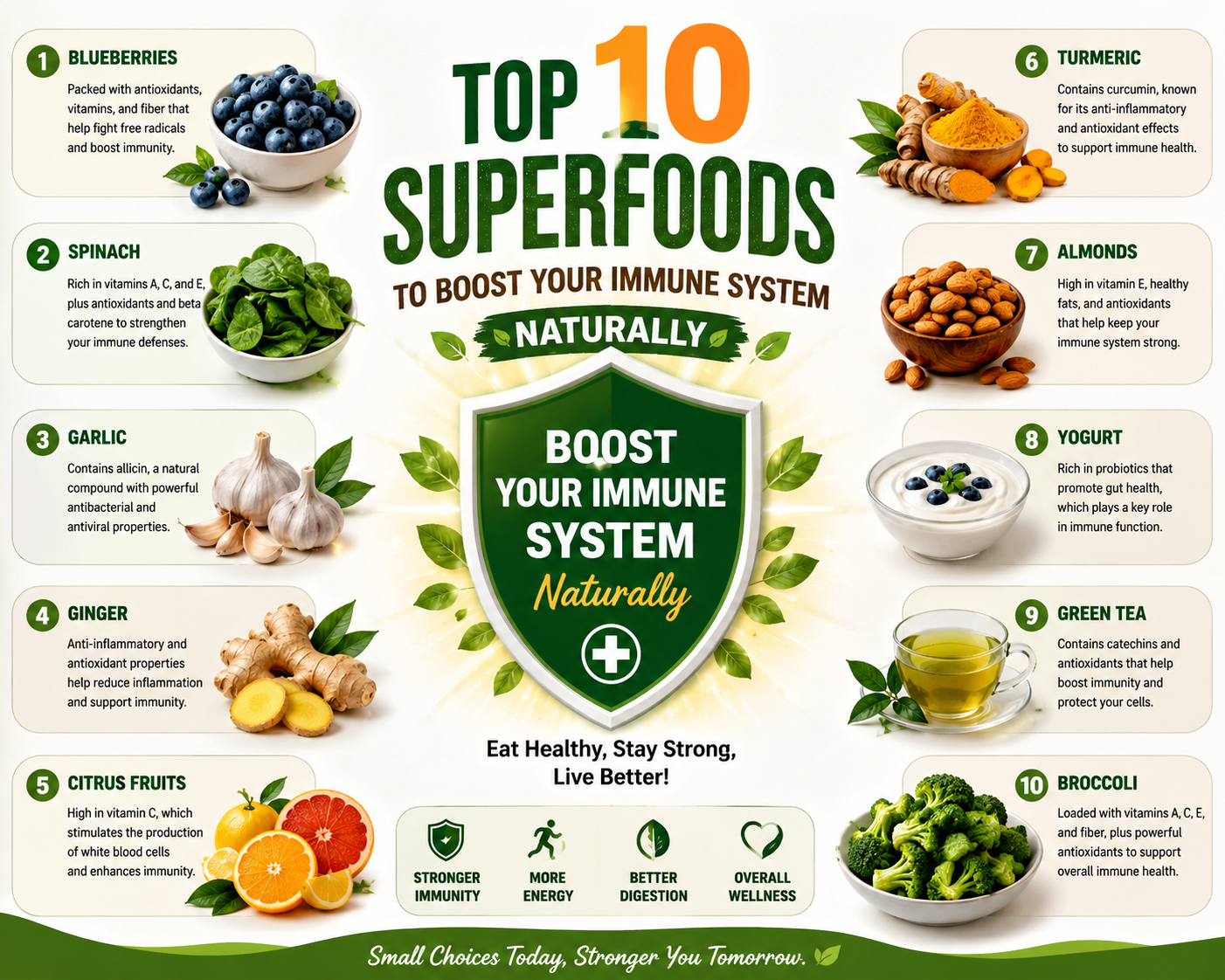 Top 10 Superfoods to Boost Your Immune System Naturally – Sekolapedia
The daily habits that outperform any capsule
If Immune Guard is the “insurance policy,” these habits are the house:
- Sleep 7–9 hours. One short night can lower natural killer cell activity. Chronic restriction is one of the most reliable ways to feel run-down.
- Eat plants like it matters. Colorful produce, legumes, nuts, and fermented foods (yogurt, kefir, kimchi, sauerkraut) feed both micronutrient status and the microbiome.
- Move most days. Moderate exercise supports immune surveillance. Extreme, unrelenting training without recovery can do the opposite.
- Get daylight and, if needed, check vitamin D. Vitamin D status is frequently low, especially in winter and in people who work indoors. It is worth a simple blood test rather than guessing.
- Wash hands and ventilate rooms. Unfashionable. Extremely effective. Supplements do not replace basic exposure control.
- Manage the stress load you can control. Cortisol is useful in bursts. Living in a constant spike changes how immune cells traffic and respond.
A supplement cannot outrun four hours of sleep and a diet of convenience food. It can fill gaps when life is imperfect — which, for most of us, is most weeks.
Where Immune Guard fits
Immune Guard is built as a daily formula, not a sick-day cocktail. The point of a 10-in-1 product is convenience and coverage:
- Vitamin C and zinc for core micronutrient support
- Elderberry and echinacea as traditional seasonal botanicals
- Turmeric and garlic for antioxidant and culinary-herb support
- Gut-oriented ingredients (L-glutamine and Lactobacillus acidophilus) to respect the gut–immune connection
- Supporting vitamins such as E and B6 that participate in antioxidant defense and immune-cell metabolism
Instead of lining up six bottles, you take one serving and keep the habit boring — which is exactly how habits survive.
How to use it well:
- Take it at the same time every day, with food if zinc bothers an empty stomach.
- Do not stack extra high-dose zinc on top without a reason. More is not automatically better; long-term high zinc can interfere with copper status.
- Keep it going through spring and summer. Immune challenges do not clock out on Memorial Day.
- Treat it as one layer. If you are pregnant, nursing, under 18, immunocompromised, or on prescription medication, talk to a clinician first.
A simple 14-day reset (no perfection required)
If your routine has drifted, use two weeks to make immune support automatic:
- Morning: Immune Guard with breakfast. Glass of water. Ten minutes outside if you can.
- Plate: Add one extra plant at lunch and dinner — fruit, salad, beans, or leftover vegetables. Not a new diet. Just more color.
- Movement: A 20–30 minute walk on days you do not train.
- Night: Same wind-down time. Phone out of the bedroom if that is the leak.
- Weekend: One fermented food. One home-cooked meal with garlic, turmeric, citrus, or leafy greens.
After two weeks, keep what stuck. That is a better outcome than a perfect plan you abandon on day five.
Who should be extra careful
- People on immunosuppressants or with autoimmune conditions should not “boost” blindly. Immune modulation is not always desirable.
- Elderberry and echinacea are not appropriate for everyone; clinicians sometimes advise caution with certain autoimmune or transplant histories.
- High-dose vitamin C can interact with some lab tests and is not ideal for people with a history of certain kidney stones.
- Food first for children; adult formulas are not automatically kid formulas.
Dietary supplements are not medicines. They do not diagnose, treat, cure, or prevent disease. If symptoms are severe, persistent, or unusual, see a healthcare professional.
The takeaway
Strong immunity is built the unglamorous way: sleep, food quality, movement, daylight, hygiene, and steady micronutrient coverage. Seasonal panic-buying is a weak substitute for that baseline.
Immune Guard exists to make the nutrient-and-botanical layer easy enough that you actually do it in September and in June. Pair the bottle with the habits, and you have a routine that matches how the immune system actually lives — every day, not only when the leaves fall.
These statements have not been evaluated by the Food and Drug Administration. This product is not intended to diagnose, treat, cure, or prevent any disease. Consult your healthcare provider before starting any supplement, especially if you are pregnant, nursing, have a medical condition, or take medication.